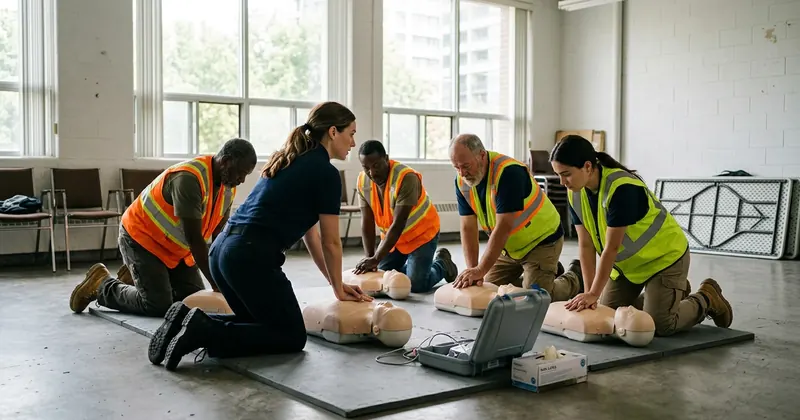
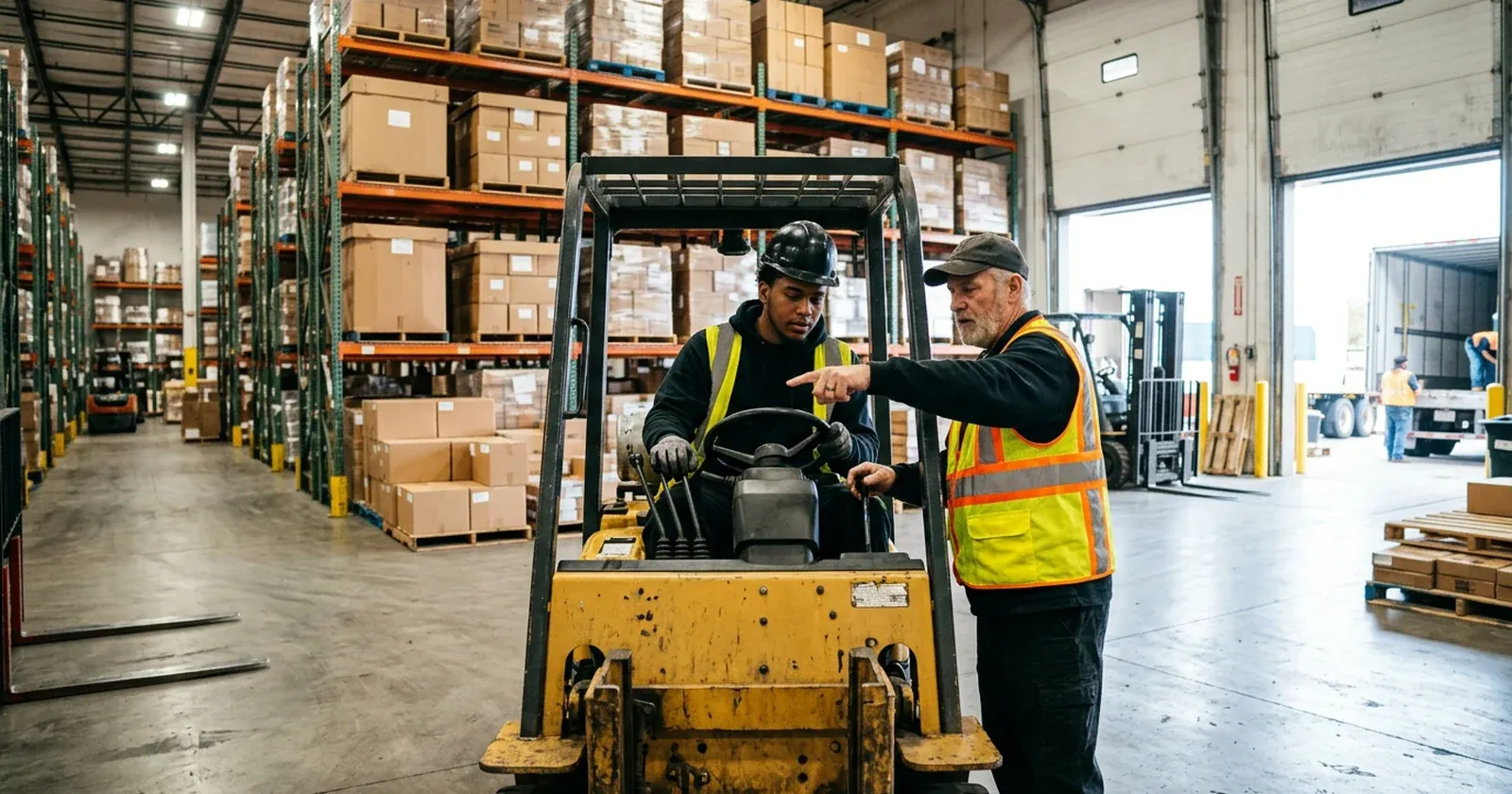
Forklift certification comes from your employer, not from OSHA. You complete formal instruction, hands-on practice and an evaluation at work, and then your employer certifies you. Your driving must be evaluated again at least once every three years.
Key takeaways
- Your employer certifies you as a forklift operator. OSHA does not issue forklift cards or approve schools.
- Training must combine formal instruction, hands-on practice and an evaluation of how you drive at work.
- Your performance must be evaluated at least once every three years (29 CFR 1910.178(l)(4)(iii)).
- Refresher training is required after unsafe driving, an accident or near-miss, a new truck type or a workplace change.
- OSHA says it is a violation of federal law for anyone under 18 to operate a forklift.
What forklift certification means
Under OSHA (Occupational Safety and Health Administration) rules, forklift certification is a record your employer makes. It shows you were trained and evaluated. The certification must include four things (29 CFR 1910.178(l)(6)):
- Your name
- The date of your training
- The date of your evaluation
- Who did the training or evaluation
The rule does not require a government license or a wallet card. It does not set a format for the certificate. OSHA has said it "cannot endorse or approve any product or services," so no school can sell you an official OSHA forklift card. An outside trainer can train and evaluate you, but your employer is still responsible. OSHA citations for failure to train are always issued to the employer.
Who needs forklift training
The rule covers powered industrial trucks, commonly called forklifts or lift trucks. That includes fork trucks, tractors, platform lift trucks, motorized hand trucks and other specialized industrial trucks powered by electric motors or internal combustion engines (29 CFR 1910.178(a)(1)). Trucks you ride and trucks you control while walking alongside both count.
The rule does not cover farm vehicles, trucks run on compressed air or nonflammable compressed gas, or vehicles meant mainly for earth moving or over-the-road hauling. Earth-moving equipment modified to accept forks is not a powered industrial truck either.
- Construction: the training rules are identical to general industry (29 CFR 1926.602(d)).
- Maritime: shipyards, marine terminals and longshoring have matching rules.
- Occasional drivers: if you have other duties and only sometimes drive a forklift, you still need training.
- Age: OSHA says it is a violation of federal law for anyone under 18 to operate a forklift.
How to get forklift certification, step by step
Training and evaluation may be done by your employer, if qualified, or by an outside training organization. The usual path looks like this:
- Ask your employer how they train. Some train in house. Others use an outside trainer, a labor union, an employers' association or another qualified organization.
- Complete formal instruction. This can be lecture, discussion, interactive computer learning, video or written material (29 CFR 1910.178(l)(2)(ii)). It does not have to happen in a classroom.
- Do practical training. The trainer demonstrates and you practice. You may drive only under the direct supervision of a qualified person, and only where it does not endanger you or other workers (29 CFR 1910.178(l)(2)(i)). In a 2025 letter, OSHA said this means the person is physically at the location.
- Pass an evaluation at work. A qualified person watches you operate the truck. A written exam alone is not enough, according to a 2005 OSHA letter.
- Get certified by your employer. The record lists the four items above.
- Inspect your truck. Trucks must be examined before being placed in service, at least daily, and after each shift if used around the clock (29 CFR 1910.178(q)(7)).
Who can train you: people with the knowledge, training and experience to train operators and judge their skills (29 CFR 1910.178(l)(2)(iii)). OSHA has said a trainer generally needs to be able to drive the equipment safely under the conditions at your workplace.
Hours and cost: OSHA does not set a number of training hours. Prices are not set by OSHA. They depend on the employer or the course provider.
What forklift training must cover
Initial training must cover truck topics and workplace topics, except topics your employer can show do not apply to safe driving at your site (29 CFR 1910.178(l)(3)).
Truck topics
- Operating instructions, warnings and precautions
- How a forklift differs from a car
- Controls, instruments, engine or motor
- Steering and maneuvering
- Visibility, including limits caused by the load
- Forks and attachments
- Capacity and stability
- Inspection and maintenance you must do
- Refueling or battery charging
- Operating limits and anything else in the operator's manual
Workplace topics
- Surface conditions
- Load makeup, stability, stacking and unstacking
- Pedestrian traffic
- Narrow aisles and tight spaces
- Hazardous (classified) locations
- Ramps and slopes
- Closed areas where carbon monoxide or diesel exhaust can build up
- Other unusual or dangerous conditions
Training must also cover the forklift rule itself. If the operator's manual covers seat belts or other restraints, you must be trained on them. If an attachment changes how the truck handles, you need training on that attachment too.
How long forklift certification lasts and renewal
The rule does not say certification expires. Instead, your performance must be evaluated at least once every three years (29 CFR 1910.178(l)(4)(iii)). In most cases this means someone watches you during normal work and asks questions. The date of your previous training sets the time frame. If you stay less than three years with the same employer, no periodic evaluation is required, but evaluations tied to initial and refresher training still apply.
Refresher training, plus an evaluation of whether it worked, is required in these cases (29 CFR 1910.178(l)(4)(ii)):
| Trigger | Rule |
|---|---|
| You were seen driving unsafely | (l)(4)(ii)(A) |
| You had an accident or near-miss | (l)(4)(ii)(B) |
| An evaluation shows unsafe driving | (l)(4)(ii)(C) |
| You are assigned a different type of truck | (l)(4)(ii)(D) |
| A workplace change could affect safe driving | (l)(4)(ii)(E) |
OSHA has said the rule sets no deadline for finishing triggered refresher training. So "renewal" really means the three-year evaluation, plus refresher training whenever a trigger happens.
Changing jobs, trucks or sites
If you already had training on a topic, and it fits the truck and working conditions, you do not need to repeat it once you are evaluated and found competent (29 CFR 1910.178(l)(5)). A new employer may decide whether your past training was adequate. It can help to ask your old employer or trainer for a copy of your certification record.
- Same type, different brand: no extra training needed, according to OSHA.
- Different type: a sit-down counterbalanced rider and a rough terrain forklift are different types, so extra training is needed.
- New site: extra training depends on whether the workplace topics differ a lot.
- Temporary workers: the staffing agency and host employer share responsibility. The host employer must verify your training, give site-specific training and evaluate you at the workplace.
Find forklift training near you on SafeDot
SafeDot is a free directory of workplace safety training providers and occupational health clinics in the United States, in English and Spanish. Today SafeDot lists 3 forklift training providers, in Massachusetts and New York. One of them says it teaches or serves in Spanish.
- Open the forklift training directory.
- Filter by city and by class language. For Spanish classes, try forklift training in Spanish.
- Send a free request for information to the provider.
SafeDot does not teach classes, issue cards or set prices. Providers set their own schedules and prices. Ask whether the class includes hands-on practice and an evaluation, and check with your employer, since your employer does the certifying. For broader safety training, see OSHA 10-Hour General Industry or the guide OSHA 10 vs. OSHA 30.
Frequently asked questions
How long does forklift certification last?
The rule does not set an expiration date. Your employer must evaluate your driving at least once every three years, and refresher training is required after unsafe driving, an accident or near-miss, a new truck type or a workplace change.
Can I get forklift certified online?
Only part of it. The classroom part can be online, but the rule requires hands-on practice and an evaluation of your driving at the workplace, with a qualified person physically there.
Does OSHA issue forklift licenses or cards?
No. OSHA does not issue forklift cards or approve training providers. Your employer certifies that you were trained and evaluated.
Do I need new forklift training at a new job?
It depends. Your new employer may accept past training that fits the truck and site, but you must still be evaluated and found competent there, and different truck types or workplace conditions may need extra training.
Can someone under 18 drive a forklift?
OSHA says it is a violation of federal law for anyone under 18 to operate a forklift. Federal youth employment rules bar most workers under 18 from operating forklifts in non-farm jobs.
Official sources
- OSHA standard 29 CFR 1910.178, Powered industrial trucks
- OSHA powered industrial trucks overview
- OSHA forklift training FAQ for general industry
- 1998 final rule on powered industrial truck operator training
- OSHA directive CPL 02-01-028 on operator training enforcement
- OSHA 2025 letter on direct supervision during forklift training
This guide is general information, not legal or medical advice. Rules change, so check the official sources and ask your employer or the agency that requires the training or exam.