
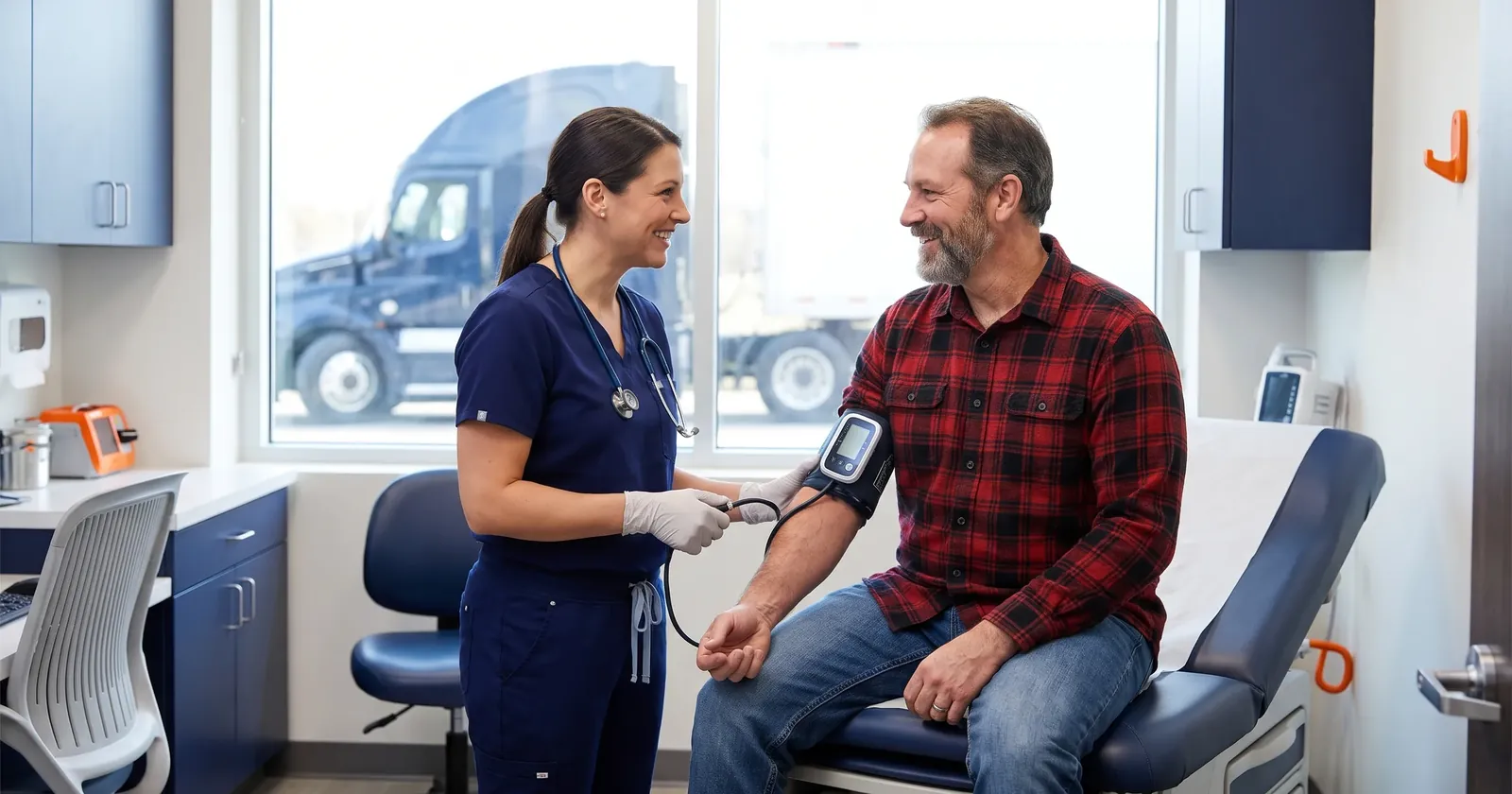
Commercial drivers need a DOT physical to keep driving. The exam itself is short, but the rules about who can do it, what it checks and how long the certificate lasts are strict. Here is what to expect.
Key takeaways
- Only a certified medical examiner listed on the FMCSA National Registry can do a DOT physical.
- A medical certificate lasts up to 24 months, or less when a health condition needs monitoring.
- Since June 23, 2025, examiners send results electronically for CDL and CLP holders, so most states no longer need a paper certificate.
- The urine test in a DOT physical is not a drug test. DOT drug testing is a separate process.
Who needs a DOT physical
Federal rules require a medical certificate for drivers of commercial motor vehicles in interstate commerce. That covers vehicles with a weight rating of 10,001 pounds or more, vehicles designed or used to carry more than 8 passengers (including the driver) for pay or more than 15 passengers (including the driver) without pay, and vehicles carrying hazardous materials in amounts that require placards. States set their own rules for drivers who stay within the state, so ask your employer or your state licensing agency what applies to you.
Who can do the exam
Only a medical examiner certified by the Federal Motor Carrier Safety Administration (FMCSA) and listed on its National Registry of Certified Medical Examiners. Medical doctors, doctors of osteopathy, physician assistants, advanced practice nurses and chiropractors can all become certified, so your examiner may not be a physician.
Many occupational health clinics have certified examiners on staff. Before you book, confirm that the examiner is on the National Registry, which you can search by location. On SafeDot you can find occupational health clinics near you and send a request to confirm they do DOT physicals.
What happens during the exam
- Health history. You fill out the driver section of the Medical Examination Report Form (MCSA-5875) about your health conditions, surgeries and medications.
- Vision. At least 20/40 in each eye and with both eyes together, with or without glasses or contact lenses, a field of vision of at least 70 degrees in each eye, and the ability to recognize the colors of traffic signals.
- Hearing. You must hear a forced whisper at 5 feet or more with your better ear, with or without a hearing aid, or pass a hearing test with an audiometer.
- Blood pressure and pulse.
- Urinalysis. It looks for protein, blood and sugar in the urine as signs of other health problems. It is not a drug test.
- Physical exam of your general appearance, eyes, ears, mouth and throat, heart, lungs, abdomen, spine, limbs and nervous system.
How long the certificate lasts
The longest a medical certificate can last is 24 months. The examiner can issue a shorter one when a condition needs to be watched, for example high blood pressure. Drivers who use insulin can be certified when their treating clinician completes the Insulin-Treated Diabetes Mellitus Assessment Form (MCSA-5870), and their certificate lasts up to 12 months.
Paperwork changed in 2025
Since June 23, 2025, certified examiners send the results of CDL and CLP holders electronically to FMCSA by midnight of the next day, and FMCSA passes them to the state licensing agency. In most states, CDL drivers no longer hand in a paper medical certificate. Not every state switched at the same time, so check with your state agency, and call them if your results do not show up after a reasonable time. If you have a medical variance, such as a vision or hearing exemption, you still need to carry it while driving.
What to bring
- Your driver's license.
- A list of your medications with doses.
- Glasses, contact lenses or hearing aids, if you use them.
- Records for ongoing conditions, such as a CPAP report for sleep apnea, notes from your heart doctor, or the MCSA-5870 form if you use insulin.
DOT physical vs. DOT drug test
A DOT physical checks whether you are medically fit to drive. A DOT drug test is a separate test that CDL drivers take before starting a safety-sensitive job and at other times set by the Department of Transportation. Many clinics do both, often in the same visit. You can find drug and alcohol testing near you on SafeDot, and safety training for your crew in our guide to OSHA 10 and OSHA 30.
Official sources
This guide is general information, not legal or medical advice. Rules change, so check the official sources and ask your employer or the agency that requires the training or exam.