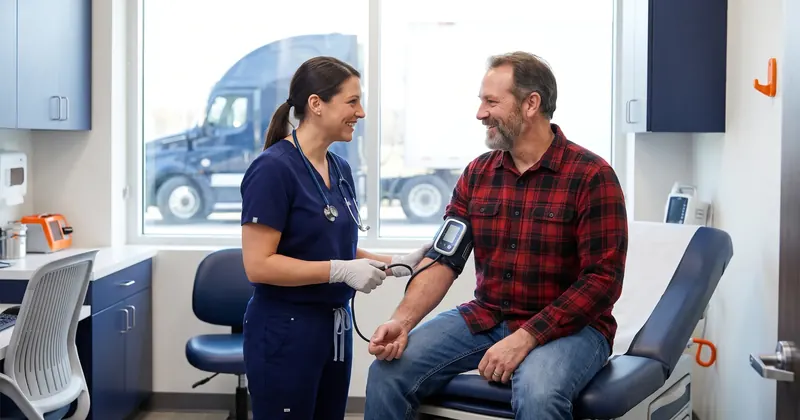
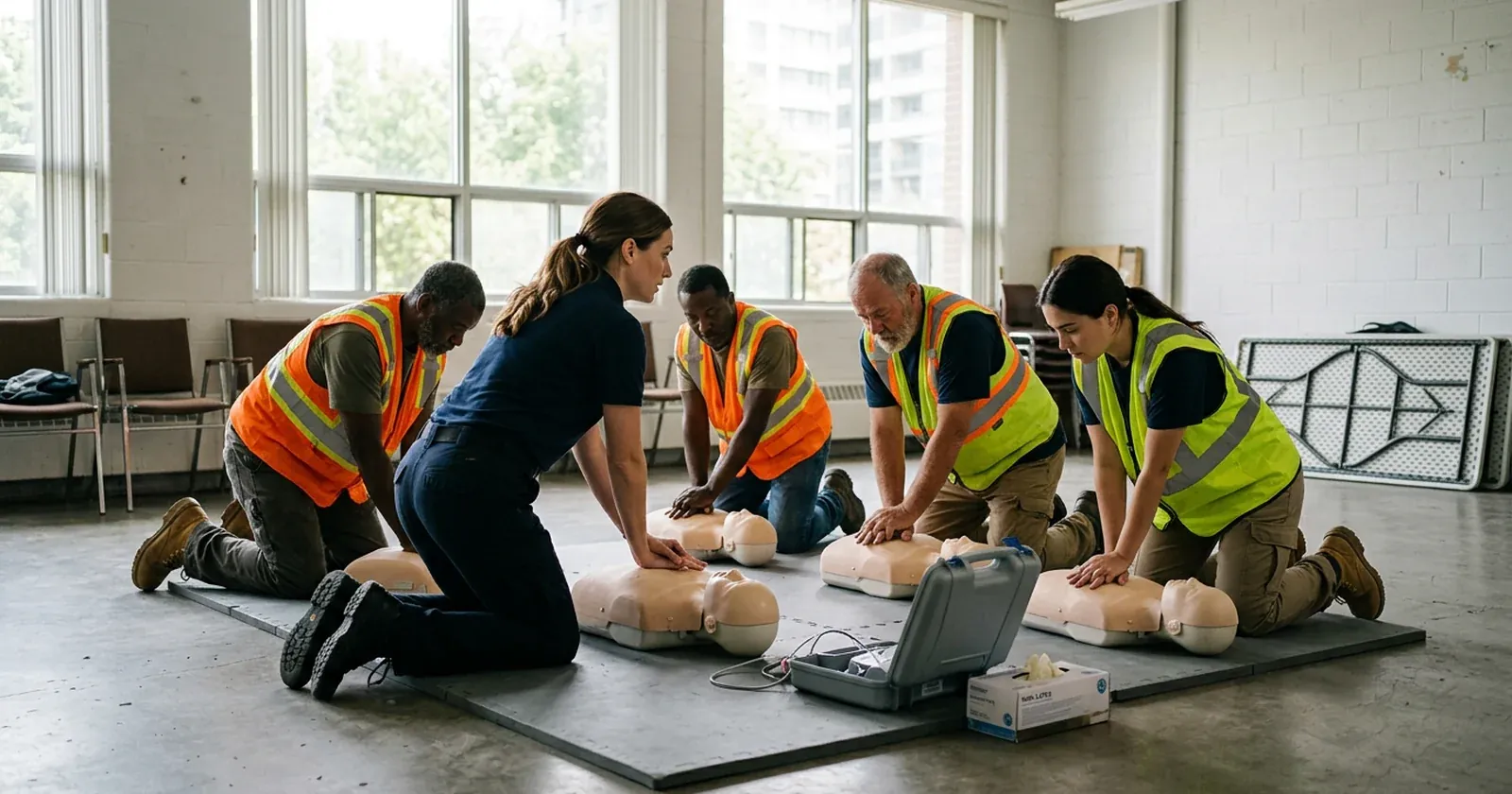
To get CPR certification for work, take a blended or in-person class that ends with a hands-on skills session with an instructor, for example from the American Heart Association (AHA) or the American Red Cross. Both groups say their cards are valid for 2 years.
Key takeaways
- OSHA requires first aid training in many workplaces and recommends CPR as part of every first aid program.
- Some standards, like confined space rescue, logging and electric power work, specifically call for CPR training.
- OSHA says online training alone does not meet its first aid training standards, because CPR has to be practiced.
- AHA and Red Cross CPR cards last 2 years, but OSHA guidance suggests retesting basic adult CPR every year.
- Ask your employer which course you need before you sign up.
Does your job require CPR certification?
Often, but not always. CPR means cardiopulmonary resuscitation. The Occupational Safety and Health Administration (OSHA) sets first aid rules, and the details depend on your workplace and its hazards.
The general rule says that if there is no infirmary, clinic or hospital near the workplace, "a person or persons shall be adequately trained to render first aid" (29 CFR 1910.151(b)). That text does not use the word "CPR." Still, OSHA recommends that CPR training be part of every first aid program.
Some standards go further. OSHA has said that if an employer is covered by one of them, CPR training would be required:
- Permit-required confined spaces: rescue employees must be trained in basic first aid and CPR, and at least one rescue team member with a current first aid and CPR certification must be available (29 CFR 1910.146(k)(2)(iii)).
- Logging: first aid and CPR training must use lecture, demonstration, practical exercise and both written and practical exams (29 CFR 1910.266 Appendix B).
- Electric power work: trained persons must be available when employees work on or near lines or equipment energized at 50 volts or more (29 CFR 1910.269(b)(1)). OSHA says this standard contains additional requirements for CPR and first aid.
State Plans (states that run their own safety programs) must be at least as effective as OSHA and may have stricter rules. Because the rules depend on your job and your state, the AHA tells students to contact their employer to pick the right course.
Online vs. hands-on: what counts for work
In a 2012 letter, OSHA wrote: "Online training alone would not meet the requirements of these training standards." The reason: "The only way these physical skills can be learned is by actually practicing them."
- OSHA recommends hands-on practice with mannequins and a partner.
- The Red Cross says online courses without an in-person skills session do not qualify for workplace certification needs.
- The AHA says you must finish a hands-on skills session to get an AHA course completion card for CPR.
Tip: Before you pay for any online-only course, ask your employer if it will be accepted. The Red Cross warns that its online-only certificate may not meet workplace requirements.
CPR class formats and how long they take
The Red Cross offers online, blended and in-person classes. The AHA offers its Heartsaver courses as classroom, blended, virtual or self-guided.
| Format | How it works | What the provider says |
|---|---|---|
| Online only | Online course; the Red Cross says skill demonstration is not available | The Red Cross says online courses without an in-person skills session do not qualify for workplace certification needs. |
| Blended | Online part first, then a skills check with an instructor | The Red Cross says its blended class gives a 2-year certification and describes it as "Satisfies OSHA workplace requirements." Your employer decides what it accepts. |
| In-person or classroom | Everything in class with an instructor | The Red Cross makes the same claim for its in-person class. Check with your employer. |
| Self-guided (AHA) | Practice and skills test on an AHA approved training simulation station | The AHA says all its Heartsaver First Aid CPR AED options lead to the same card. |
How long is a class? The Red Cross says CPR certification "takes just a few short hours." For Heartsaver First Aid CPR AED, the AHA estimates about 3.5 hours in a classroom, about 3 hours online plus about 2 hours of skills for blended, or about 2 hours plus 1 hour of practice and skills for self-guided. The exact time depends on the course and the provider.
Which CPR class should you take?
- Heartsaver CPR AED: for workers outside healthcare who need CPR and AED (automated external defibrillator) skills for work, the AHA says this course "is probably best for you."
- Heartsaver First Aid CPR AED: adds first aid. The AHA calls it "OSHA-compliant."
- Heartsaver Pediatric First Aid CPR AED: the AHA says it is designed to meet requirements for childcare workers in all 50 states.
- BLS (Basic Life Support): the AHA and Red Cross describe it as mainly for healthcare professionals. The AHA says first aid is not included in its BLS courses.
Red Cross CPR classes cover adults and children unless you choose a single-population class. AHA CPR Anytime kits give a certificate of completion, but they are not meant for people who need a CPR eCard.
How long does a CPR certification last?
Both the Red Cross and the AHA say their CPR cards are valid for 2 years. OSHA itself does not set a national expiration period. The confined space rule asks for a "current certification" without defining "current" (29 CFR 1910.146(k)(2)(iii)).
OSHA guidance (not a rule) says basic adult CPR retesting should happen every year, and first aid skills should be reviewed every three years. The Red Cross reports that less than half of participants can pass a skills test one year after training. Your employer may ask you to refresh sooner than 2 years.
Renewing: Red Cross renewal courses are for people whose credentials are still valid but near expiration. They are shorter than standard classes and extend certification for another two years. For an AHA card, contact an AHA Training Center, or the one that issued your last card, about renewal options and cost. If your card already expired, ask the provider which class you need. An expired card does not stop you from helping: the Red Cross says you can still perform CPR.
How to get a CPR certification: step by step
- Ask your employer which course and which provider they accept.
- Choose a blended or in-person class with a hands-on skills session.
- Find a class near you and check the language it is taught in.
- If it is blended, finish the online part before your skills session.
- Pass the hands-on skills session with the instructor.
- Get your card. The Red Cross issues a digital certificate with a unique ID and QR code that employers can check online. The AHA issues a course completion eCard.
- Give a copy to your employer and write down the expiration date so you can renew on time.
Find CPR classes near you on SafeDot
SafeDot is a free directory of workplace safety training providers and occupational health clinics in the U.S., in English and Spanish. Our CPR, AED and first aid class directory lists 86 providers today in Massachusetts, New Jersey and New York. CPR school listings come from the schools' own websites.
You can filter by city and by the language of the class. Try CPR classes in Spanish. When you find a provider, send a free request for information.
SafeDot does not teach classes, issue cards or set prices. Providers set their own schedules and prices, and AHA Training Centers are independent businesses that set their own fees. Need more training for your job? Browse all safety training or read OSHA 10 vs. OSHA 30.
Frequently asked questions
How long does a CPR certification last?
AHA and Red Cross CPR cards are valid for 2 years. OSHA does not set a national expiration, but its guidance suggests retesting basic adult CPR every year, and your employer may have its own rule.
Can I get CPR certified online for work?
Usually not with online-only training. OSHA says online training alone does not meet its first aid training standards. The Red Cross says you need an in-person skills assessment if you need certification for your employer, and the AHA requires a hands-on skills session to get its CPR course completion card.
How much does a CPR class cost?
There is no national price. AHA Training Centers set their own fees and schedules, and other providers set their own prices, so ask the provider directly.
Does OSHA require CPR training?
It depends on your job. OSHA recommends CPR as part of every first aid program, and some standards, such as permit-required confined spaces, logging and electric power work, specifically call for CPR training.
Where can I find CPR classes near me?
You can search by city and class language in SafeDot's CPR, AED and first aid directory. The Red Cross also has a class search by city or ZIP code.
Official sources
This guide is general information, not legal or medical advice. Rules change, so check the official sources and ask your employer or the agency that requires the training or exam.