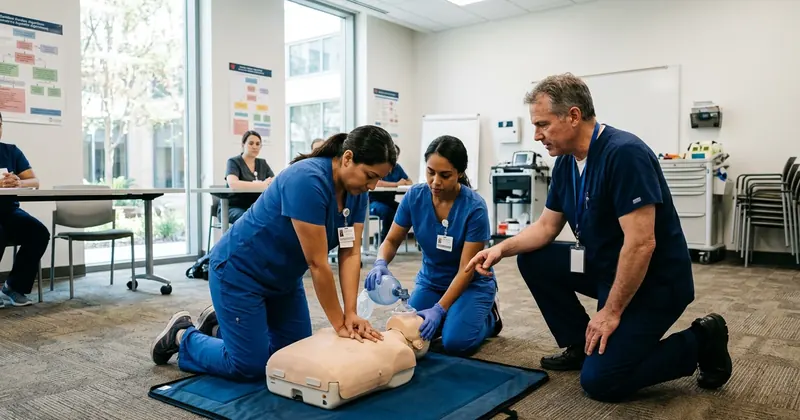
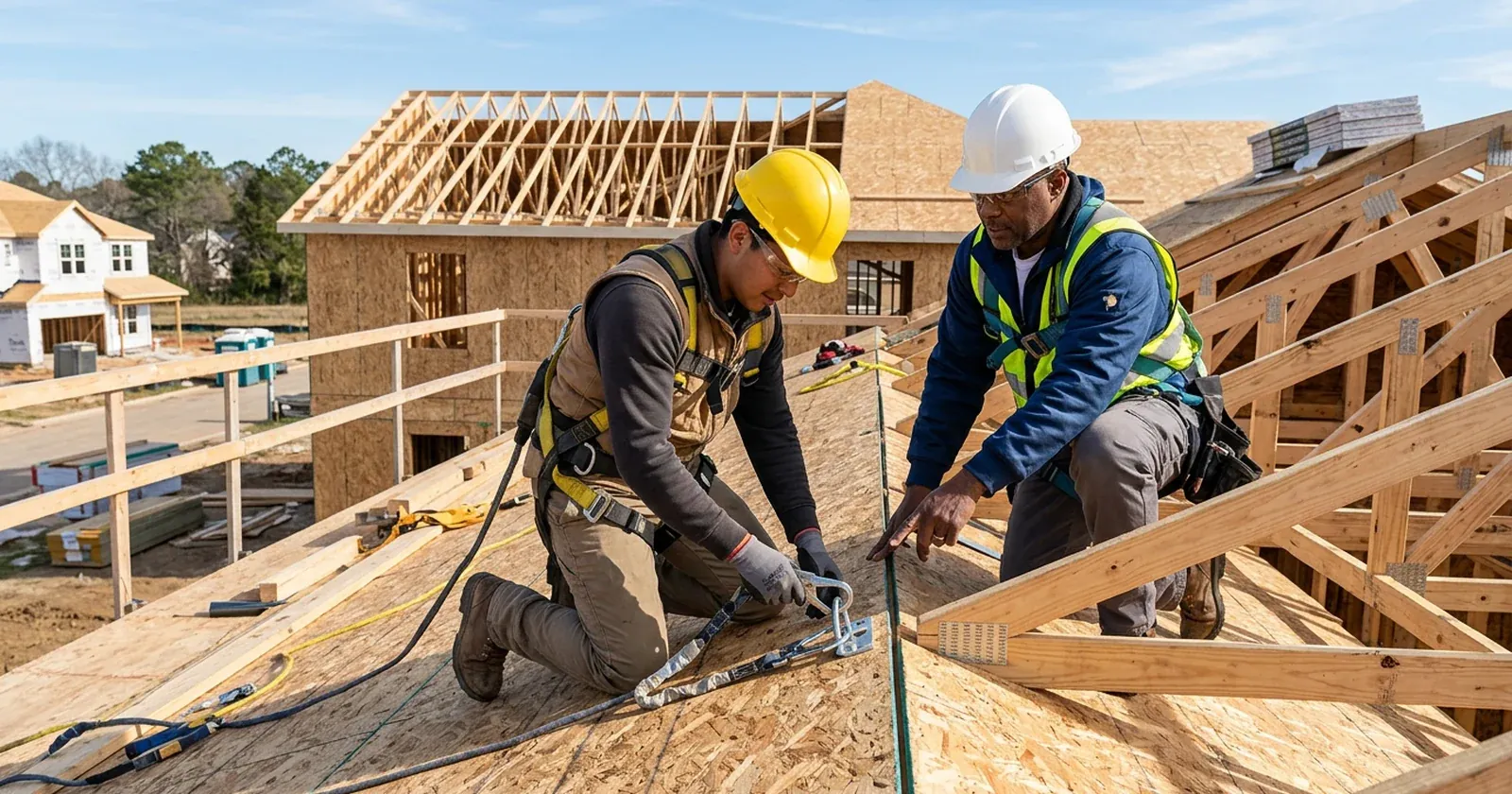
Construction workers who might be exposed to fall hazards, and general industry workers who use personal fall protection systems, must be trained by their employer. OSHA sets who can teach and what topics to cover, but no minimum hours and no expiration date.
Key takeaways
- OSHA requires fall protection at 4 feet in general industry, 5 feet in shipyards, 6 feet in construction and 8 feet in longshoring.
- In construction, a competent person must train each worker who might be exposed to fall hazards, and the employer keeps a written certification record (29 CFR 1926.503).
- OSHA does not issue a fall protection or competent person certification. Your employer chooses the competent person and gives them authority.
- Training has no fixed expiration date. Retraining is required when the workplace, the equipment or your skills change.
- An OSHA 10 or OSHA 30 card does not, by itself, meet the training requirements of any OSHA standard.
Who needs fall protection training
OSHA (the Occupational Safety and Health Administration) requires fall protection once you work at certain heights. The height depends on your industry.
| Industry | Fall protection required at |
|---|---|
| General industry | 4 feet |
| Shipyards | 5 feet |
| Construction | 6 feet |
| Longshoring | 8 feet |
OSHA also requires fall protection when you work over dangerous equipment and machinery, no matter the fall distance. Your employer must provide required personal protective equipment at no cost to you, and must train you about job hazards in a language you understand.
Training rules follow the same split. Construction is covered by 29 CFR (Code of Federal Regulations) Part 1926, Subpart M. General industry is covered by 29 CFR 1910.30. Shipyards and longshoring have their own rules, which this guide does not cover. See OSHA Maritime training if you work in those settings.
Why it matters: OSHA says falls are among the most common causes of serious work related injuries and deaths. In 2016, the Bureau of Labor Statistics (BLS) reported that 991 construction workers died on the job, and 38.7 percent of those deaths came from falls.
Construction fall protection training: what OSHA requires
The employer must provide a training program for each employee who might be exposed to fall hazards (29 CFR 1926.503(a)(1)). The program must teach you to recognize the hazards of falling and the procedures to follow to reduce them.
A competent person must train you, as necessary, in these areas (29 CFR 1926.503(a)(2)):
- The nature of fall hazards in your work area
- How to erect, maintain, take down and inspect the fall protection systems you will use
- How to use guardrails, personal fall arrest systems, safety nets, warning lines, safety monitoring systems and controlled access zones
- Your role in the safety monitoring system, when one is used
- Limits on mechanical equipment during roofing work on low-sloped roofs
- Handling and storing equipment and materials, and putting up overhead protection
- Your role in fall protection plans
- The standards in Subpart M
The written certification record
Your employer must prepare a written certification record with your name, the date(s) of training, and the signature of the trainer or the employer (29 CFR 1926.503(b)(1)). If your employer relies on training from another employer, the record shows the date your employer decided that training was adequate. Only the latest record must be kept (29 CFR 1926.503(b)(2)). OSHA does not require a written training program or a written test, but employers may use tests to document training.
Retraining
Your employer must retrain you if it has reason to believe you lack the understanding and skill needed (29 CFR 1926.503(c)). Examples include changes in the workplace, changes in the fall protection systems or equipment, or signs that you have not kept the knowledge or skill. The rule sets no fixed refresher interval. Retraining depends on these events, not the calendar.
Scaffolds and ladders have their own rules
If you work on a scaffold, a person qualified in the subject must train you (29 CFR 1926.454(a)). Workers who erect, take down, move, repair or inspect scaffolds must be trained by a competent person (29 CFR 1926.454(b)). Ladder and stairway users must also be trained by a competent person (29 CFR 1926.1060(a)(1)). See scaffold training providers.
Competent person fall protection training
A competent person is someone who can identify existing and predictable hazards and who has authorization to take prompt corrective measures to eliminate them (29 CFR 1926.32(f)).
OSHA says there are currently no specific OSHA standards regarding competent persons. In one letter, OSHA said finishing a course does not, alone, make someone a competent person. The definition requires authority to fix hazards, and "no course can provide that authority, since it can only be provided by the employer."
So a "competent person fall protection" course is a class from a training provider. It can build your knowledge. Its length, content and price depend on the provider. Your employer decides whether it is enough and who serves as the competent person.
Equipment inspection is part of this. A personal fall arrest system must be inspected before each use by a worker trained by a competent person. That worker does not have to be the competent person. Annual inspections instead of checks before each use would violate 29 CFR 1926.502(d)(21). If equipment has stopped a fall, a competent person must inspect it before reuse (29 CFR 1926.502(d)(19)).
General industry fall protection training
In warehouses, plants and other general industry workplaces, training must happen before you are exposed to a fall hazard. It applies to each employee who uses personal fall protection systems or who must be trained under other parts of the subpart (29 CFR 1910.30(a)(1)). A qualified person must train you (29 CFR 1910.30(a)(2)).
Minimum topics include how to recognize fall hazards, how to reduce them, how to install, inspect, operate, maintain and take down your personal fall protection, and correct hook-up, anchoring and tie-off. Equipment training also covers dockboards, rope descent systems and designated areas (29 CFR 1910.30(b)). Training must be given in a manner you understand (29 CFR 1910.30(d)).
| Item | Construction (1926.503) | General industry (1910.30) |
|---|---|---|
| Who trains | Competent person | Qualified person |
| Written certification record | Required | Not in the rule |
| Retraining | When site, equipment or skills change | When site, equipment or skills change |
| Minimum hours | None set | None set |
Does an OSHA 10 or OSHA 30 card count?
Not by itself. OSHA says the Outreach program is voluntary and does not meet the training requirements for any OSHA standard. None of the Outreach courses is a certification. Employers must still train you on the specific hazards of your job, including falls.
Some states, cities and employers do require a card to work. Learn more in OSHA 10 vs. OSHA 30 or find an OSHA 10 Construction class. State Plans may also have different or stricter fall rules, so the details depend on your state.
Checklist before you work at height
- Know the height trigger for your industry.
- Ask who trained you and, in construction, whether you are on the written certification record.
- Make sure the training was in a language you understand.
- Get your fall protection equipment from your employer at no cost.
- Inspect your harness and lanyard before each use, if you were trained to.
- Report any gear that stopped a fall so a competent person can check it.
- Ask for retraining when the site or the equipment changes.
How to find fall protection training near you on SafeDot
SafeDot is a free directory of workplace safety training providers in English and Spanish. It lists 128 providers for fall protection training in Florida, Massachusetts, North Carolina, New Jersey, New York and Texas. One of them says it teaches or serves in Spanish.
- Open the fall protection training page.
- Filter by your city and the language of the class. For Spanish, try this search.
- Send a free request for information. Ask about hands-on practice, equipment used, schedule and price.
- Show the course outline to your employer before you sign up, since your employer decides if it is adequate.
SafeDot does not teach classes, issue cards or set prices. Providers set their own schedules and prices.
Frequently asked questions
Does fall protection training expire?
OSHA's construction and general industry rules set no expiration date and no fixed refresher interval. Retraining is required when the workplace, the equipment or your skills change.
Is there an OSHA fall protection certification?
No. OSHA does not issue or approve fall protection or competent person certifications. In construction, your employer keeps a written certification record of your training (29 CFR 1926.503(b)).
Who can teach fall protection training?
In construction, a competent person (29 CFR 1926.503(a)(2)). In general industry, a qualified person (29 CFR 1910.30(a)(2)).
Can I take fall protection training online?
The OSHA sources we reviewed do not say whether fully online training meets the rules. It depends on your employer, who must make sure the training covers the required topics, including using and inspecting your equipment.
Do I have to do a practice fall during training?
No. OSHA has said a personal drop experience is not required. Some providers may include one, so ask before you enroll.
Official sources
This guide is general information, not legal or medical advice. Rules change, so check the official sources and ask your employer or the agency that requires the training or exam.