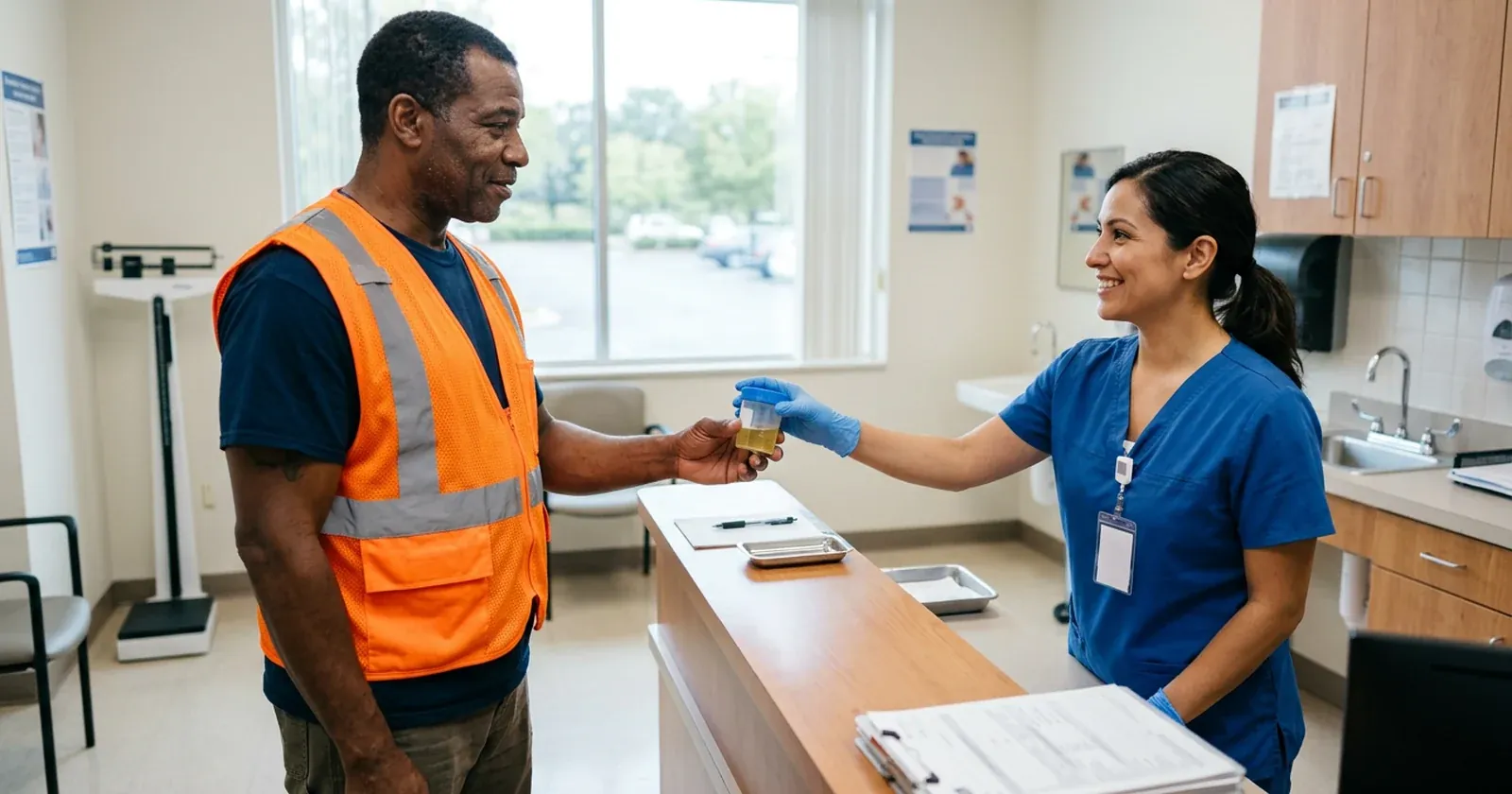
A DOT drug test is a federally required lab test for transportation workers in safety-sensitive jobs. It checks for five drug classes (marijuana, cocaine, amphetamines, opioids and PCP) using urine or oral fluid. It must be kept completely separate from any non-DOT test your company runs on its own.
Key takeaways
- A DOT drug test checks five drug classes: marijuana, cocaine, amphetamines, opioids and phencyclidine (PCP).
- Labs may not test a DOT specimen for any other drugs (49 CFR 40.82).
- Non-DOT tests follow your employer's own policy and need a separate specimen.
- A DOT physical is not a drug test. Drug testing is a separate process for CLP and CDL holders.
- CBD and state medical marijuana are not valid explanations for a marijuana positive.
What a DOT drug test tests for
DOT stands for the U.S. Department of Transportation. Its testing rules are in 49 CFR Part 40. A lab must test a DOT specimen for five drugs or drug classes, and it must not test that specimen for any other drugs (49 CFR 40.82). DOT calls this the "5-panel" test. On the Custody and Control Form (CCF), the collector checks the box for "THC, COC, PCP, OPI, AMP."
| Drug class | What is included |
|---|---|
| Marijuana | Marijuana metabolites (THC) |
| Cocaine | Cocaine metabolite (benzoylecgonine) |
| Amphetamines | Amphetamine, methamphetamine, MDMA, MDA |
| Opioids | Codeine, morphine, 6-AM (heroin), hydrocodone, hydromorphone, oxycodone, oxymorphone |
| PCP | Phencyclidine |
Since January 1, 2018, DOT requires confirmation testing for 14 drugs under the 5-panel test. The old "Opiates" group is now called "Opioids." Brand names DOT lists in that group include OxyContin, Percocet, Vicodin, Norco and Dilaudid.
About fentanyl: the current urine cutoff table (49 CFR 40.85) does not list fentanyl. A Federal Register document dated September 2, 2025 is titled "Addition of Fentanyl to the Department of Transportation's Drug-Testing Panel." Ask your employer or testing provider which panel applies on your test date.
One exception: some Federal Railroad Administration (FRA) post-accident tests check more than the five drug classes and also require a blood draw.
DOT drug test cutoffs
Labs compare the amount of drug found with a cutoff, measured in nanograms per milliliter (ng/mL). On the first (initial) test, a result below the cutoff is negative. At or above it, the lab runs a confirmation test. A confirmation result at or above its cutoff is a confirmed positive (49 CFR 40.85(b) and (c)).
| Urine (ng/mL) | Initial | Confirmation |
|---|---|---|
| Marijuana (THCA) | 50 | 15 |
| Cocaine (benzoylecgonine) | 150 | 100 |
| Codeine, morphine | 2000 | 2000 |
| Hydrocodone, hydromorphone | 300 | 100 |
| Oxycodone, oxymorphone | 100 | 100 |
| 6-AM (heroin) | 10 | 10 |
| PCP | 25 | 25 |
| Amphetamine, methamphetamine | 500 | 250 |
| MDMA, MDA | 500 | 250 |
Oral fluid (saliva) tests use lower cutoffs, listed in 49 CFR 40.91. For example, marijuana (THC) is 4 ng/mL initial and 2 ng/mL confirmation.
How the test works and what happens after
- Specimen: only urine and oral fluid are authorized for DOT drug testing. An employer using oral fluid needs a lab certified by the U.S. Department of Health and Human Services (HHS) that processes oral fluid.
- No instant tests: devices that give instant results are not allowed. Your specimen is sent to a certified lab.
- MRO review: if the lab reports a positive, adulterated or substituted result, you talk with a Medical Review Officer (MRO). The MRO checks for a legitimate medical explanation before reporting to your employer.
- Split specimen: you have 72 hours from the MRO's verification to ask for your split ("B") specimen to be tested at another lab. Who pays is between you and your employer.
- Prescriptions: prescription and over-the-counter drugs are allowed if a licensed physician prescribed them, judged them consistent with safe job performance, and you take the prescribed dose.
Medical marijuana under state law is not a valid explanation (49 CFR 40.151(e)). DOT also says CBD use is not a legitimate medical explanation for a marijuana positive, and CBD labels may be misleading about THC.
Refusals include not showing up, leaving before the collection is done, adulteration, substitution and not cooperating. DOT's advice is "comply, then complain." After a violation, your employer must remove you from safety-sensitive work right away. To return, you need a Substance Abuse Professional (SAP) evaluation, you must finish the SAP's recommendations, pass a follow-up SAP evaluation and get a negative return-to-duty test.
Who gets DOT tested and when
About 6.5 million transportation workers in safety-sensitive jobs are covered by rules from FAA, FMCSA, FRA, FTA, PHMSA and the U.S. Coast Guard (USCG). For drivers, the Federal Motor Carrier Safety Administration (FMCSA) covers people with a commercial learner's permit (CLP) or commercial driver's license (CDL) who drive a vehicle that:
- has a gross vehicle weight rating of 26,001 lb or more, or
- is designed to carry 16 or more people, counting the driver, or
- hauls placarded hazardous materials, at any size.
DOT tests happen at these times:
- Pre-employment: before you are hired or moved into a safety-sensitive job.
- Random: unannounced, with every covered worker having an equal chance. Owner-operators must join a consortium for random testing.
- Post-accident: after an accident that meets the agency's rule.
- Reasonable suspicion: when a trained supervisor sees signs of drug use or alcohol misuse.
- Return-to-duty and follow-up: at least 6 unannounced follow-up tests in the first 12 months. These drug tests are directly observed.
Since January 6, 2020, FMCSA requires violations to be reported to the Drug and Alcohol Clearinghouse. Employers must check it before hiring and at least once a year.
DOT vs. non-DOT drug test
"In addition to DOT testing, your company may have its own testing program." These are non-DOT tests, done under the employer's own authority. The two must be completely separate in all respects (49 CFR 40.13(a)).
| Topic | DOT test | Non-DOT test |
|---|---|---|
| Rules | 49 CFR Part 40 and agency rules | Your employer's policy |
| Drugs | Only the five DOT classes | Employer may test more drugs, using a separate specimen |
| Form | DOT CCF | Employer must not use the DOT CCF (49 CFR 40.13(g)) |
| Who | Only DOT-regulated employees (49 CFR 40.13(h)) | Depends on the employer |
| Federal effect | Removal, SAP process, Clearinghouse for FMCSA | FMCSA: no federal prohibition from a non-DOT positive |
When both are done together, the DOT test comes first and must be finished before the non-DOT test begins. Leftover urine is thrown away, and you give a separate sample for the company test (49 CFR 40.13(b)). No one may change or ignore a DOT result because of a non-DOT result. A negative test from your own doctor does not cancel a verified DOT positive (49 CFR 40.13(f)).
DOT sources do not say which panels, cutoffs or specimen types (such as hair) a non-DOT test may use. If someone mentions a "10-panel" test, it depends on your employer, so check your company's policy.
Does a DOT physical include a drug test?
No. FMCSA's Medical Examiner's Handbook says drug and alcohol testing for CLP and CDL holders "is not part of the physical qualification examination." Drug tests are not required as part of the periodic physical exam (49 CFR part 391, subpart E). See our DOT physical guide for what the exam covers.
If a DOT urine collection is done as part of a DOT-required physical, leftover urine may be used for medical tests such as glucose, but only after the DOT specimen is sealed in its bottles (49 CFR 40.13(d)). A non-DOT drug test given during a physical to decide medical qualification is not a DOT test (49 CFR 40.13(e)).
Find a drug testing clinic near you on SafeDot
SafeDot is a free directory of occupational health clinics and safety training providers in English and Spanish. It lists 2,856 occupational medicine providers, drawn from the NPI Registry. SafeDot does not perform tests or set prices.
- Ask your employer if your test is DOT or non-DOT.
- Open the drug and alcohol testing page or browse clinics.
- Filter by your city and language, for example clinics with Spanish service.
- Send a free request to ask about DOT collections, oral fluid, hours and price.
- Keep a list of your prescriptions in case the MRO calls you.
Frequently asked questions
Does a DOT physical include a drug test?
No. FMCSA says drug and alcohol testing is not part of the physical qualification exam. It is a separate process for CLP and CDL holders.
What does a DOT drug test test for?
Five drug classes: marijuana, cocaine, amphetamines (including methamphetamine, MDMA and MDA), opioids (including heroin, oxycodone and hydrocodone) and PCP (49 CFR 40.82).
Is a DOT drug test a 5 panel or 10 panel?
Part 40 lists five drug classes, and labs may not test DOT specimens for other drugs (49 CFR 40.82). Some FRA post-accident tests check more than five classes, and a September 2, 2025 Federal Register document addresses adding fentanyl, so ask which panel applies on your test date. Panels used in company (non-DOT) tests depend on your employer.
Can CBD make me fail a DOT drug test?
DOT tests for marijuana, not CBD. But CBD use is not accepted as a medical explanation for a marijuana positive, and CBD labels may be misleading about THC.
Where can I get a DOT drug test?
Your employer usually tells you where to go. You can also search drug and alcohol testing providers on SafeDot and send a free request.
Official sources
This guide is general information, not legal or medical advice. Rules change, so check the official sources and ask your employer or the agency that requires the training or exam.