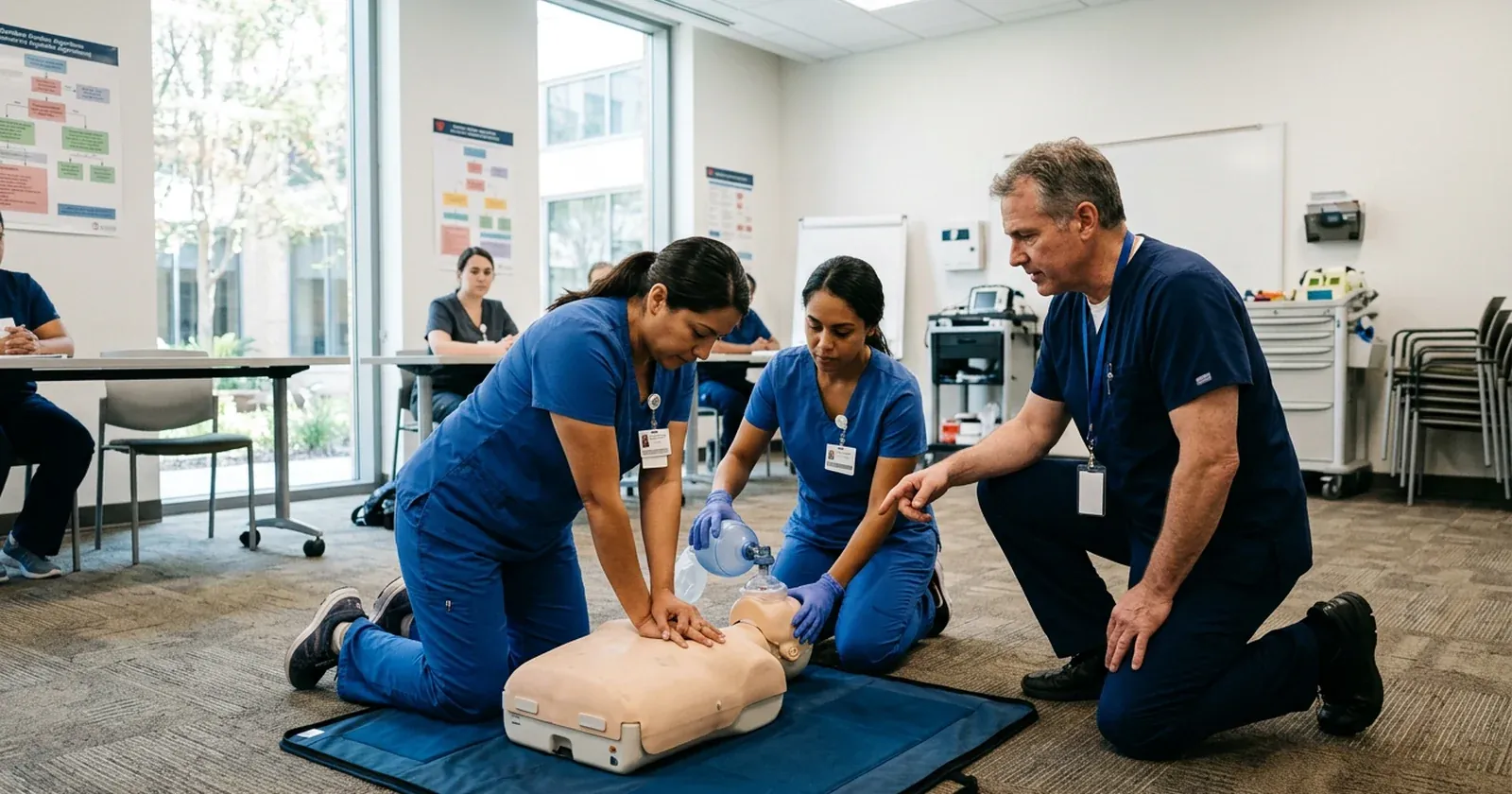
BLS (Basic Life Support) certification is not the same as CPR. BLS covers CPR, AED use, choking care for all ages and teamwork, and it is built for healthcare and public safety workers. Workplace first aid, CPR and AED courses are built for people with little or no medical training.
Key takeaways
- BLS includes CPR, AED use and choking care for adults, children and infants, plus teamwork skills.
- BLS is designed for nurses, physicians, EMTs, CNAs and other healthcare and public safety workers.
- OSHA rules talk about first aid and CPR, not BLS, and online training alone does not meet them.
- AHA and Red Cross BLS cards are valid for two years, and work certification needs a hands-on skills session.
- Ask your employer or school which course and which card they accept before you sign up.
What is BLS certification?
BLS stands for Basic Life Support. The American Red Cross describes it as the care that first responders, healthcare providers and public safety professionals give to anyone in cardiac arrest, in respiratory distress or with a blocked airway.
A BLS course teaches CPR (cardiopulmonary resuscitation), how to use an AED (automated external defibrillator) and how to relieve choking in patients of every age. It also trains you to think fast, solve problems and work as part of a team. The American Heart Association (AHA) says its BLS course teaches both single-rescuer and team skills, with a focus on high-quality CPR, for use before the hospital and inside healthcare facilities.
When you pass, you get proof of training. The AHA issues a BLS Provider Course Completion Card. The Red Cross issues a digital certificate with a unique ID and QR code that employers can check online.
Is BLS the same as CPR?
No. CPR is one skill inside BLS. The Red Cross says its BLS curriculum "goes beyond a cardiac focus." Its BLS topics include:
- Rapid assessment and visual survey
- CPR and AED for adults, children and infants
- Obstructed airways (choking)
- Opioid overdoses
- Critical thinking, problem solving, communication and teamwork
- The emergency medical services (EMS) system
- Legal considerations and precautions
Workplace CPR courses are built for people with little or no medical training. The Red Cross calls CPR classes "the foundation of workplace safety training." The AHA version, Heartsaver First Aid CPR AED, is for anyone who needs an OSHA-compliant course completion card or simply wants to be ready for an emergency.
| Compare | BLS | Workplace first aid, CPR and AED |
|---|---|---|
| Made for | Nurses, physicians, paramedics, EMTs, CNAs and other healthcare and public safety workers | Workers and anyone with little or no medical training |
| Main skills | CPR, AED, ventilations, choking care for all ages, teamwork | First aid, CPR and AED use |
| In-person class time | About 4.5 hours (AHA) or about 4 to 5 hours (Red Cross) | About 3.5 hours (AHA Heartsaver classroom) |
| Card valid for | 2 years (AHA and Red Cross) | 2 years for AHA Heartsaver. For other courses, ask the provider. |
| Examples | AHA BLS Provider, Red Cross BLS | AHA Heartsaver First Aid CPR AED, Red Cross First Aid/CPR/AED |
One warning: the AHA says its Heartsaver Basic course does not generally meet workplace or regulatory requirements. The AHA tells you to contact your employer to make sure you pick the correct course.
Who needs BLS? BLS for healthcare providers
The Red Cross says BLS is designed for healthcare and public safety clinicians. It trains nurses, physicians, EMS professionals, certified nursing assistants (CNAs) and others to respond to breathing and cardiac emergencies in adults, children and infants. It is most often taken by nurses, physicians, paramedics and emergency medical technicians (EMTs), plus other clinicians who need to keep their credentials or meet employer requirements. It can also help prepare you for a career in medicine, as a police officer or as a firefighter.
The Red Cross says its BLS courses meet "a variety of certification and licensing requirements," but it does not name which ones. Whether you need BLS depends on your employer, your school program and your state. Ask them first.
If you work outside healthcare or public safety, for example in construction, a warehouse or trucking, BLS may be more than you need. Workplace first aid and CPR courses are built for you. Your employer decides which course it accepts. Our guide on CPR certification for work explains those classes.
What OSHA requires (and what it does not)
OSHA (the Occupational Safety and Health Administration) does not mention BLS in the rules and letters behind this guide. Its rules talk about first aid and CPR.
- General industry: if there is no infirmary, clinic or hospital in near proximity to the workplace, a person must be adequately trained to give first aid, and first aid supplies must be readily available (29 CFR 1910.151(b)). OSHA has long read "near proximity" as care within no more than 3 to 4 minutes. In offices, where serious injuries are less likely, up to 15 minutes may be reasonable.
- Construction: when no infirmary, clinic, hospital or physician is reasonably accessible, a person with a valid first aid certificate from the U.S. Bureau of Mines, the American Red Cross or verifiable equivalent training must be available at the worksite (29 CFR 1926.50(c)).
- CPR by name: OSHA recommends, but does not require, CPR training for every workplace. Some standards do require it, including permit-required confined spaces (29 CFR 1910.146), logging (29 CFR 1910.266) and electric power work (29 CFR 1910.269).
- Hands-on practice: in a 2012 letter, OSHA said online training alone does not meet these first aid training standards, because skills like CPR can only be learned by actually practicing them.
- Refreshers: OSHA does not set a retraining interval. Its Best Practices Guide recommends instructor-led CPR and AED retraining at least once a year. The 2-year card is the training provider's rule, not OSHA's.
The Red Cross says its blended and classroom BLS formats satisfy OSHA workplace requirements. Still, OSHA lets employers tailor their first aid program, so ask your employer whether a BLS card covers what they need.
How to get BLS certification: step by step
- Ask which card is accepted. Check with your employer, school or licensing body. Neither the AHA nor the Red Cross says its BLS card can replace the other's.
- Choose a format. Classroom is all in person. Blended means online lessons first (about 1 to 2 hours), then an in-person skills session (60 minutes to 2 hours for AHA, 2 to 3 hours for Red Cross).
- Avoid online-only certificates for work. The Red Cross says its online-only certificate of completion has no skills check and may not meet workplace requirements.
- Do the hands-on skills session. The AHA says its full BLS Provider Course includes skills practice and testing.
- Get your card. AHA and Red Cross BLS cards are valid for two years.
- Renew on time. The AHA BLS Renewal Course takes about 3 hours. The Red Cross recertification course is for people whose certification is current or close to expiring, and computer-adaptive testing can finish it in up to 50% less time. Check the exact cutoff with the provider.
For AHA BLS, continuing education credit may be available depending on the course option and your profession. If you need an accommodation, contact the AHA Training Center that runs your class.
How to find BLS and CPR classes near you on SafeDot
SafeDot is a free directory of workplace safety training providers and occupational health clinics, in English and Spanish. Today it lists 121 CPR, AED and first aid providers in Massachusetts, New Jersey and New York. Of those, 16 say they teach or serve in Spanish.
- Open the CPR, AED and first aid page and filter by your city.
- Filter by class language if you want Spanish, for example CPR classes in Spanish.
- Send a free request for information. Ask: Do you teach BLS? Is it AHA or Red Cross? Is the skills session in person? What are the price and schedule?
SafeDot does not teach classes, issue cards or set prices. Each provider sets its own schedule and price. Listings for CPR and first aid schools come from the schools' own websites, so confirm details directly with the school. For more topics, browse all guides.
Frequently asked questions
What is BLS certification?
BLS (Basic Life Support) certification shows you completed a course in CPR, AED use and choking care for adults, children and infants, including team skills. It is designed for healthcare and public safety workers such as nurses, physicians, EMTs and CNAs.
Is BLS the same as CPR?
No. CPR is one part of BLS. The Red Cross says BLS is meant for healthcare clinicians and first responders and goes beyond a cardiac focus, while workplace CPR courses are built for people with little or no medical training.
How long does BLS certification last?
AHA and Red Cross BLS cards are valid for two years. OSHA does not set a retraining interval, but its Best Practices Guide recommends instructor-led CPR and AED retraining at least once a year.
Can I get BLS certification completely online?
For work, plan on a hands-on skills session. The Red Cross says BLS certification requires an in-person skills session, and its online-only certificate may not meet workplace requirements. OSHA also says online training alone does not meet its first aid training standards.
How do I find BLS certification near me?
Use the SafeDot CPR, AED and first aid directory to filter by city and class language, then send a free request asking whether the school teaches BLS. The Red Cross and AHA also have their own class search tools.
Official sources
- American Red Cross: BLS for healthcare providers
- American Red Cross: BLS certification formats and timing
- American Heart Association: BLS course options
- American Heart Association: Heartsaver First Aid CPR AED course options
- OSHA: Medical services and first aid (29 CFR 1910.151)
- OSHA letter of interpretation on online first aid and CPR training (2012)
This guide is general information, not legal or medical advice. Rules change, so check the official sources and ask your employer or the agency that requires the training or exam.